

In reality, it means coordinating a venue, dozens of guest rooms, multiple vendors, a multi-day event schedule, transport for out-of-town guests, and a budget that can shift the moment the guest count changes. None of that is complicated once you understand the sequence — but it does need a plan, not just a mood board.
This guide walks through that plan: how to pick a destination, what things actually cost in, how to build a realistic timeline, and what separates a wedding that runs smoothly from one that leaves the couple exhausted by day two.
Why Destination Weddings in India Are Popular
The shift isn't really about scale anymore — it's about what the wedding feels like to attend. A few patterns are showing up consistently across couples planning weddings this year:
- Smaller, more intentional guest lists. Couples are choosing 100–250 close guests over 500+ acquaintances, and putting the money saved into experience quality.
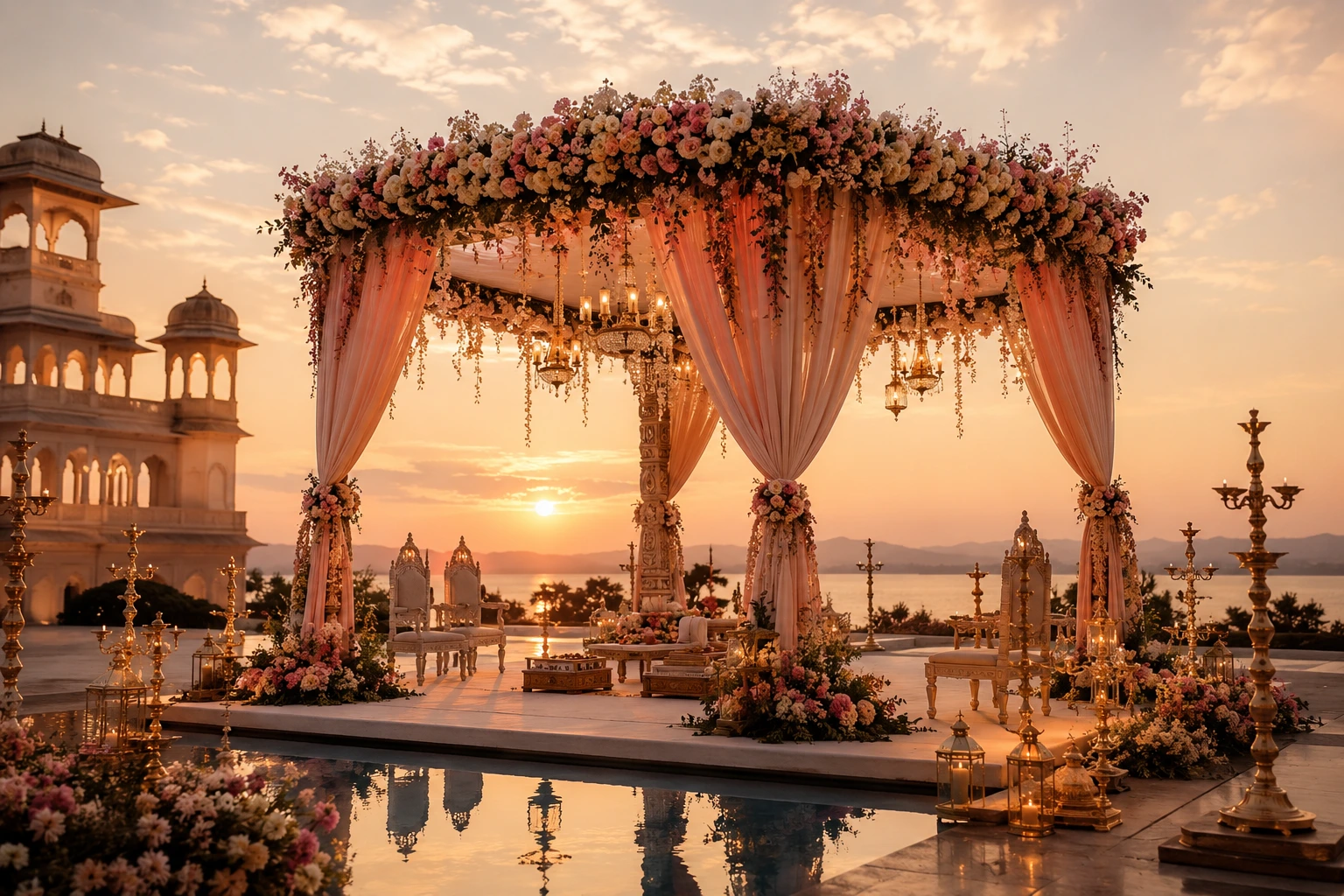
- Heritage and palace properties. Forts, havelis, and palace hotels in Rajasthan continue to draw couples who want a wedding with visual and cultural weight built in, without needing heavy decor.
- Beach and resort formats. Goa and coastal Kerala remain popular for couples who want a relaxed, holiday-like structure to the wedding week.
- Multi-day celebrations as the norm, not the exception — most couples are now planning at least three distinct days of events rather than a single ceremony.
- Guest experience treated as part of the wedding, not an afterthought — welcome hampers, curated local excursions, and thought-out transport are increasingly standard rather than a luxury add-on.
- A blend of tradition and contemporary design — classic rituals like haldi, mehendi, and pheras staying intact, styled and produced in a more modern, less cluttered way.
- Sustainability-conscious choices — digital invites, local sourcing, and less disposable decor, driven as much by cost-efficiency as by environmental concern.
None of this means bigger budgets are disappearing — luxury and large-scale weddings are very much still happening. It means couples across budget levels are being more deliberate about where the money and attention go.
How to Choose the Right Destination for Your Wedding
Before comparing cities, it helps to run through the practical filters that actually decide whether a destination works for your wedding.
- Accessibility — How far is the nearest airport or major railway station from the venue, and how easy is that route for elderly guests or families with young children?
- Travel time for guests — A destination that's a two-hour drive from the airport plays very differently for a 3-day wedding than a same-day arrival city.
- Weather and season — Outdoor ceremonies, especially in Rajasthan or Goa, are heavily season-dependent. Check historical weather patterns for your planned dates.
- Venue availability — Popular heritage properties and 5-star resorts get booked 9–18 months in advance for the peak wedding season (roughly October to February).
- Accommodation options — Does the destination have enough rooms nearby to house your full guest list without splitting people across multiple properties far apart?
- Local wedding regulations — Some cities and heritage properties have noise curfews, fire-safety restrictions on decor, or licensing requirements for large gatherings.
- Vendor ecosystem — A strong local network of caterers, decorators, photographers, and entertainment reduces cost and coordination risk versus flying every vendor in.
- Overall wedding budget — Some destinations carry a premium simply because of venue exclusivity or logistics (island resorts, for instance).
- Guest experience — Will guests have things to do between events, or will they be confined to a single property for three days?
- Wedding style — A palace wedding, a beach wedding, and a hill-station wedding each call for a different destination personality.
| Destination | Best For | Wedding Style | Ideal Season | Budget Level | Key Consideration |
|---|---|---|---|---|---|
| Jaipur | Couples wanting heritage grandeur with strong city connectivity | Palace, royal, cultural | October–March | Mid to luxury | Excellent vendor ecosystem and flight/rail access, but peak-season venues book out early |
| Udaipur | Couples wanting lakeside romance and photogenic backdrops | Palace, lakeside, luxury | September–March | Mid to ultra-luxury | Limited room inventory near premium lake venues; book far in advance |
| Jodhpur | Couples wanting dramatic fort and desert-city settings | Heritage, royal, dramatic | October–February | Mid to luxury | Hot in summer; fort venues often have strict decor and sound restrictions |
| Jaisalmer | Couples wanting a desert, off-beat aesthetic | Desert, boutique, intimate | November–February | Mid to luxury | Remote location increases guest travel time and logistics cost |
| Goa | Couples wanting a relaxed, holiday-style wedding | Beach, resort, casual-luxury | November–February | Affordable to luxury | Peak season sees high demand for beachfront venues and flights |
| Kerala | Couples wanting a cultural, backwater, or hill setting | Traditional, backwater, nature | October–March | Affordable to mid-range | Monsoon season (June–September) limits outdoor planning |
| Rishikesh | Couples wanting a spiritual, riverside, intimate wedding | Spiritual, intimate, nature | September–April | Affordable to mid-range | Best suited to smaller guest counts; limited large-scale venue inventory |
| Hyderabad | Couples wanting a city wedding with strong catering and hospitality infrastructure | Royal, contemporary, city | October–February | Mid-range | Good connectivity; less "getaway" feel than smaller destinations |
| Delhi NCR | Couples prioritising convenience for a majority-local guest list | Contemporary, banquet, city | October–March | Affordable to luxury | Best when most guests are already based in or near the city |
No destination is universally "best" — the right one depends on your guest base, budget, and the kind of week you want your guests to have.
## Best Destination Wedding Destinations in India ### JaipurJaipur remains one of the most consistently chosen cities for couples who want a wedding with visual grandeur but don't want to sacrifice connectivity. The city has direct flights from most major Indian metros and several international routes, which matters when your guest list includes NRI families or older relatives who can't manage long connecting journeys.
- Wedding personality: Royal, heritage-forward, colour-rich
- Ideal venue type: Palace hotels, forts, heritage havelis, and luxury resorts on the city outskirts
- Best suited for: Couples who want a multi-day wedding with strong cultural texture and don't want to compromise on guest logistics
- Guest experience: Jaipur's own tourism draw (Amer Fort, City Palace, local markets) gives guests something to do outside the wedding schedule
- Weather considerations: Best between October and March; summers are extremely hot and not advisable for outdoor events
- Accessibility: Strong — international airport, well-connected by rail and road from Delhi NCR
- Budget positioning: Mid-range to ultra-luxury, depending on the property chosen
- Possible limitations: The most sought-after heritage properties get booked well in advance for peak season, and pricing rises sharply in December and January
Because Jaipur has one of the most mature wedding vendor ecosystems in the country — decorators, caterers, photographers, and entertainment professionals who work destination weddings regularly — couples often find it easier to execute a complex, multi-day event here than in less-established destinations. This is also why so many couples specifically search for a destination wedding planner in Jaipur rather than trying to coordinate long-distance with vendors they haven't worked with before.
Udaipur
Udaipur's lake-facing venues are among the most photographed wedding settings in India, but room inventory near the premium properties is genuinely limited. Couples set on a specific lakeside palace should expect to book 12–18 months out for peak dates.
- Wedding personality: Romantic, lakeside, palatial
- Ideal venue type: Lake-facing palace hotels and heritage resorts
- Best suited for: Intimate to mid-sized luxury weddings
- Weather considerations: September to March is ideal; avoid peak monsoon
- Accessibility: Direct flights from major metros; smaller airport than Jaipur
- Budget positioning: Mid to ultra-luxury
- Limitations: Guest accommodation can be split across multiple properties if the group is large, which adds transport coordination
Jodhpur
Jodhpur offers a starker, more dramatic aesthetic than Jaipur or Udaipur — fort venues set against the Blue City backdrop. It suits couples who want a bold, less conventionally "romantic" visual identity.
- Best suited for: Couples wanting dramatic architecture and a distinct, less commonly used setting
- Weather considerations: October to February; summer heat is intense
- Limitations: Some fort venues carry decor and sound restrictions that need to be confirmed early, and the city has fewer large-format venue options than Jaipur
Jaisalmer
Jaisalmer works well for couples deliberately choosing an off-beat, desert setting over the more commonly booked Rajasthan cities.
- Best suited for: Smaller, design-forward weddings that lean into the desert landscape
- Limitations: Its remoteness adds real travel time and cost, which matters more for elderly guests or larger groups
Goa
Goa continues to suit couples who want their wedding to feel like a holiday for guests rather than a formal, tightly-scheduled event.
- Best suited for: Beach ceremonies, casual-luxury resort weddings, mixed Indian-and-international guest lists
- Weather considerations: November to February; avoid monsoon months
- Limitations: Peak season sees high demand on both flights and beachfront venues, so early booking matters more here than almost anywhere else
Kerala
Kerala offers a different register entirely — backwaters, hill stations, and a strong culturally rooted hospitality tradition.
- Best suited for: Couples wanting a traditional or nature-forward wedding with a slower, immersive pace
- Weather considerations: October to March; monsoon (June–September) limits outdoor options
- Limitations: Fewer large-capacity luxury venues compared to Rajasthan or Goa
Rishikesh
Rishikesh suits couples specifically looking for a spiritual, riverside setting, generally for smaller guest counts.
- Best suited for: Intimate ceremonies with a meaningful, less conventional setting
- Limitations: Large-scale venue inventory is limited; this destination works best for guest lists under roughly 150
Hyderabad
Hyderabad is a strong choice when the couple wants royal-style venues and strong catering infrastructure without the "getaway" travel time of Rajasthan.
- Best suited for: Couples with a large local or regional guest base who still want a grander, more curated wedding than a standard city banquet hall
- Limitations: Feels less like a destination and more like a well-executed city wedding, which is either an advantage or a drawback depending on what the couple wants
Delhi NCR
Delhi NCR isn't a traditional "destination," but many couples treat it as one — hosting a multi-day, resort-style wedding at a farmhouse or 5-star property just outside the city.
- Best suited for: Couples whose guest base is largely local, who want destination-style production without the travel logistics
- Limitations: Doesn't offer the same visual distinctiveness as Rajasthan, Goa, or Kerala
There's no single number here, and any article that gives you one flat figure is oversimplifying. Cost is driven by guest count, destination, season, venue category, number of functions, and production complexity — the same wedding can cost dramatically different amounts depending on whether it's 100 guests at a boutique property or 400 guests at a 5-star palace across four days.
What the Budget Typically Covers
- Venue rental
- Guest rooms and accommodation
- Food and beverages across all functions
- Decor and styling
- Photography and videography
- Makeup and styling for the couple and family
- Entertainment (DJ, live acts, folk performers)
- Guest transportation (airport transfers, local movement)
- Guest hospitality (welcome hampers, concierge support)
- Invitations and stationery
- Mehendi and other function-specific setups
- Sound, lighting, and stage production
- Planner or coordination fees
- Miscellaneous costs and contingency
Rough Planning Categories
These are approximate ranges to help with early budgeting conversations, not fixed prices. Always confirm current numbers with venues and vendors directly, since pricing shifts by season and property.
- Intimate wedding (under 100 guests, single or two-day format): Generally the most cost-efficient entry point, especially at boutique or resort properties outside peak season.
- Mid-range destination wedding (150–250 guests, 2–3 day format): The most common category — a full multi-day format with a mid-tier heritage or resort venue.
- Luxury wedding (250–400 guests, 3–4 day format at premium heritage or 5-star properties): Costs rise sharply with venue exclusivity, guest room inventory, and production scale.
- Large-scale luxury wedding (400+ guests, multiple premium venues or a full palace buyout): This is where costs become highly variable and depend almost entirely on the specific property and vendor choices.
The honest way to plan is to fix your guest count and destination first, then get real quotes from 2–3 venues and vendors before assuming a number. Wedding budgets built on assumed averages tend to fall apart once room blocks and F&B minimums come into the picture.
Destination Wedding Budget Breakdown
A useful starting point for allocating a wedding budget across categories — treat this as a planning guideline, not an industry rule:
| Category | Approximate Share of Budget |
|---|---|
| Accommodation | 20–25% |
| Food & beverages | 20–25% |
| Venue | 15–20% |
| Decor & production | 10–15% |
| Photography/videography | 5–8% |
| Entertainment | 5–8% |
| Guest transportation | 3–5% |
| Guest hospitality | 2–4% |
| Planning & coordination | 8–12% |
| Contingency | 5–10% |
The contingency line is the one couples most often skip — and the one that matters most. Weather changes, last-minute guest additions, and vendor substitutions are common enough that a 5–10% buffer should be treated as non-negotiable, not optional.
How Many Days Should a Destination Wedding Be?
| Format | Works Best For |
|---|---|
| 2-day wedding | Intimate weddings, tighter budgets, guests with limited travel time |
| 3-day wedding | The most common format — enough room for haldi/mehendi, sangeet, and the wedding day without over-scheduling guests |
| 4-day wedding | Large families, NRI weddings where guests are travelling far and want to make the most of the trip, and luxury weddings with multiple distinct events |
A Practical 3-Day Sample Itinerary
Day 1 — Arrivals and Welcome Guest check-ins through the day, followed by a low-key welcome dinner in the evening. This gives guests time to recover from travel before the event schedule intensifies.
Day 2 — Haldi, Mehendi, and Sangeet Daytime haldi and mehendi functions, followed by a sangeet or cocktail evening. This is typically the most logistically dense day and benefits from a clear, guest-friendly schedule.
Day 3 — Wedding Ceremony and Reception The main ceremony, followed by the reception or a farewell brunch the next morning if guests are staying an extra day.
Avoiding Guest Fatigue
The most common planning mistake here isn't too few events — it's too many, packed too tightly. A few practical fixes:
- Build in genuine downtime between functions, not just travel-time buffers
- Avoid scheduling more than one major event per day when possible
- Give guests optional, not mandatory, activities between functions
- Communicate the schedule clearly in advance so guests can plan energy and outfits accordingly
Complete Destination Wedding Planning Timeline
12–18 Months Before
Shortlist destinations, set a preliminary budget, draft the guest list, and begin evaluating planners and venues. Popular heritage properties for peak season get booked in this window.
9–12 Months Before
Confirm the venue and room blocks. Lock in major vendors — caterer, decorator, photographer. Settle on the overall wedding concept and function list.
6–9 Months Before
Send save-the-dates or formal invitations. Finalise decor direction and entertainment bookings. Start guest logistics planning — travel and accommodation communication.
3–6 Months Before
Confirm guest travel arrangements, finalise outfits, lock the food and beverage menu, and confirm the run-of-show for each function. Send detailed guest communication with schedules and travel information.
1–3 Months Before
Finalise seating plans, rooming lists, event-day timelines, and vendor coordination schedules. Confirm final headcounts with the venue and caterer.
Final 2 Weeks
Set emergency contacts, complete final vendor payments, confirm weather backup plans, and prepare for guest arrivals and on-ground execution.
How to Choose a Destination Wedding Venue
Beyond how a venue looks in photographs, evaluate it against these practical factors:
- Number of rooms and total guest capacity
- Indoor and outdoor space options
- Availability of multiple distinct areas for different functions
- Rain or weather backup arrangements
- In-house food policy versus outside catering permissions
- Outside vendor policy (decor, entertainment, photography)
- Decor restrictions, especially at heritage or protected properties
- Music and noise curfews
- Check-in and check-out timing flexibility
- Parking capacity for guest and vendor vehicles
- Power backup reliability
- Physical accessibility for elderly or differently-abled guests
- Guest privacy, especially at properties that host multiple events simultaneously
- Event-end curfew times mandated by local regulation
- Taxes, service charges, and other additional costs not included in the headline quote
Venue Inspection Checklist
- ☐ Confirmed total room inventory and proximity to the main venue
- ☐ Walked through both indoor and outdoor event spaces
- ☐ Verified weather backup plan and equipment
- ☐ Reviewed in-house catering policy and outside vendor charges
- ☐ Confirmed decor and structural restrictions in writing
- ☐ Checked noise curfew and local event-timing regulations
- ☐ Verified power backup capacity for full event load
- ☐ Reviewed parking capacity against expected guest and vendor vehicle count
- ☐ Confirmed all taxes and service charges included in the final quote
- ☐ Requested references from other couples who hosted weddings at the property
Should You Hire Destination Wedding Planners in India?
For most multi-day destination weddings, the honest answer is yes — not because couples can't plan a wedding themselves, but because of what a planner absorbs on your behalf:
- Venue sourcing and comparison across multiple destinations
- Vendor selection and rate negotiation
- Guest accommodation and room-block management
- Transportation coordination for arrivals, transfers, and departures
- Decor and production planning across multiple function spaces
- Building and managing the event-day timeline
- Guest hospitality — from welcome kits to on-ground support
- On-ground coordination and problem-solving during the actual event days
- Ongoing budget tracking against the original plan
That said, planning without a professional planner is realistic for couples hosting a smaller, single-location wedding with a guest list under roughly 100, especially if they already have a strong local vendor network or family support on the ground. The calculation changes once you're managing multiple venues, 150+ guests, or a wedding location neither the couple nor their families know well.
How to Choose the Right Destination Wedding Planner
Before signing with any wedding planning company, ask direct questions and expect direct answers:
- How many destination weddings have you managed, and in which destinations?
- Do you work with vendors local to the destination, or fly everyone in?
- Which destinations do you handle regularly, and which are new to you?
- What exactly is included in your planning fee, and what's billed separately?
- How do you track and manage the wedding budget throughout planning?
- Who from your team will physically be present on the wedding days?
- How do you handle guest logistics — transport, accommodation, and communication?
- What's your process if a vendor cancels or underdelivers close to the wedding date?
- How are cancellations, postponements, or scope changes handled contractually?
- Can you share references or past work from couples in a similar budget range?
A planner's Instagram feed or follower count says very little about how they'll handle a vendor cancellation two days before your wedding. Ask about process, not just portfolio.
Destination Wedding Guest Management
Guest experience shapes how the wedding is remembered as much as the ceremony itself. Key pieces to plan for:
- Early save-the-date communication so guests can plan travel and leave
- Clear travel information — flight/train options, nearest airports, recommended arrival windows
- Airport and railway transfers organised in advance
- Smooth hotel check-in, ideally with a dedicated welcome desk
- Thoughtful room allocation, especially for families and elderly guests
- Welcome hampers with essentials and a printed event schedule
- Clear, accessible event schedules shared digitally and physically
- Dietary requirements collected and communicated to caterers in advance
- Extra support arranged for elderly guests — transport, seating, rest areas
- Emergency contact information shared with all guests
- Optional local sightseeing or excursions for guests with downtime
- Organised departure coordination to avoid last-day chaos
Guest experience isn't a separate project from the wedding — it needs to be planned in parallel from the start, not bolted on in the final weeks.
Wedding Functions to Include in a Destination Wedding
Common functions couples choose from, mixed and matched based on family tradition and guest profile:
- Welcome dinner
- Haldi
- Mehendi
- Sangeet
- Cocktail evening
- Wedding ceremony
- Reception
- Post-wedding brunch
- Farewell event
Not every function needs to be included. A couple with a smaller, close-knit guest list might combine haldi and mehendi into one relaxed afternoon and skip a separate cocktail evening. The itinerary should reflect the guest profile and the couple's actual priorities, not a checklist of every function seen at other weddings.
Destination Wedding Trends to Watch in India
- Intimate celebrations with guest lists prioritising closeness over headcount
- Personalised guest experiences — curated welcome kits, local excursions, thoughtful room details
- Multi-day storytelling where each function has a distinct visual and emotional tone rather than repeating the same decor
- Heritage venues continuing to be in high demand for couples wanting built-in visual character
- Local food and cultural experiences woven into the menu and entertainment rather than generic catering
- Sustainable choices — digital invitations, local sourcing, reusable decor elements
- Minimal, intentional decor replacing maximalist styling in several segments
- Curated entertainment — live acts and folk performers alongside or instead of standard DJ sets
- Personalised wedding stationery as a smaller but meaningful design touchpoint
- Smaller guest lists paired with higher per-guest spend on experience quality
- Technology-assisted guest communication — event apps and digital itineraries replacing printed-only schedules
- Weather-conscious planning, with backup arrangements built into the original event design rather than added as an afterthought
How to Make a Destination Wedding More Sustainable
- Use digital invitations instead of printed cards where possible
- Source flowers and food locally rather than flying in perishables
- Choose reusable or repurposable decor elements over single-use installations
- Plan food quantities carefully to reduce waste, especially across multi-day catering
- Set up refillable water stations instead of relying solely on bottled water
- Build local experiences into the guest itinerary instead of importing entertainment from elsewhere
- Choose gifting that's practical or locally sourced rather than purely decorative
- Plan guest transportation to minimise unnecessary trips and vehicle idling
None of this needs to be presented as a dramatic lifestyle choice — most of these are simply better planning decisions that also happen to reduce waste and cost.
Common Destination Wedding Planning Mistakes
- Choosing a destination before working out a realistic budget
- Booking a venue without confirming enough guest accommodation nearby
- Underestimating travel time between the airport, hotel, and venue
- Overloading the itinerary with back-to-back events and no downtime
- Skipping a weather backup plan for outdoor functions
- Underestimating total transportation costs across arrivals, transfers, and local movement
- Signing vendor contracts without reviewing cancellation and change terms carefully
- Leaving no contingency budget for last-minute changes
- Failing to communicate the event schedule clearly to guests in advance
- Choosing a venue based only on photographs without an in-person or video walkthrough
Destination Wedding Checklist
| Category | Task |
|---|---|
| Budget | Set overall budget and category-wise allocation |
| Guest list | Finalise headcount and NRI/international guest breakdown |
| Destination | Shortlist and confirm final destination |
| Venue | Confirm venue, review contract, and inspect in person |
| Rooms | Block accommodation for full guest list |
| Planner | Hire planner and confirm scope of services |
| Vendors | Confirm caterer, decorator, photographer, entertainment |
| Decor | Finalise theme and decor plan per function |
| Food | Finalise menu and dietary accommodations |
| Entertainment | Book performers, DJ, or live acts |
| Photography | Confirm shot list and coverage across all days |
| Travel | Arrange guest flights/trains and airport transfers |
| Invitations | Finalise and send save-the-dates and invitations |
| Guest hospitality | Plan welcome hampers and concierge support |
| Wedding functions | Confirm final function list and schedule |
| Contracts | Review all vendor agreements and cancellation terms |
| Payments | Track advance and final payment schedules |
| Weather backup | Confirm indoor alternative for outdoor events |
| Emergency planning | Share emergency contacts with all guests and vendors |
Final Takeaway
The right destination wedding isn't the most expensive one, and it isn't the one with the most Instagram-worthy backdrop either. It's the one where the destination, venue, budget, and guest experience actually work together — where your family can travel without exhaustion, your budget holds up through the final week, and the schedule leaves room for people to actually enjoy themselves.
Planning a destination wedding in India? Start by defining your guest count, preferred destination, wedding dates, and approximate budget. From there, an experienced wedding planning team — such as Weddings and Events by Amitesh — can help turn those decisions into a practical, executable wedding plan grounded in real venue and vendor knowledge, not just aesthetics.